Sunnah of the Week – Dressing with Dignity: The Sunnah of Clothing & Footwear
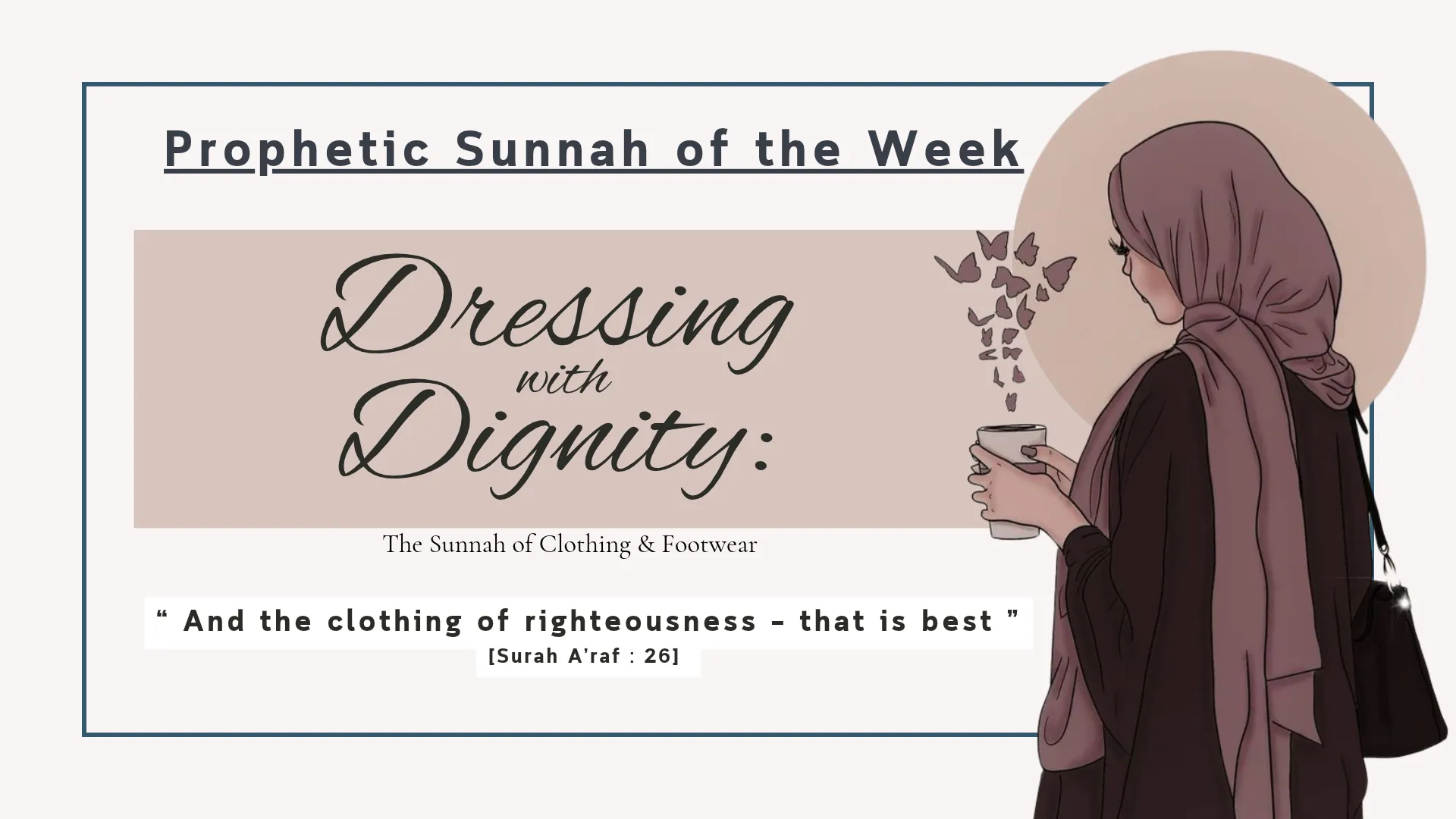
“And the clothing of righteousness – that is best” [Surah A’raf : 26]
Small Steps to Success
- Level 1: Begin with saying the dua & starting from the right
- Level 2: Avoid fashion trends
- Level 3: Intend to dress for the sake of Allah
The Prophet ﷺ said: “Eat, drink, and dress neatly, but do not be extravagant or arrogant.” (Sunan Ibn Majah 3605)
Umar ibn al-Khattab (RA) wore simple clothing despite his high status, avoiding pride.
He once said: “The best clothing is that which neither makes you look lowly nor arrogant.” (Kitab al-Zuhd by Ibn Hanbal)
It is reported that during his caliphate, he patched his clothes instead of wearing luxurious garments, despite ruling a vast empire. (Al-Muwatta of Imam Malik)
The Prophet ﷺ would always check his appearance before meeting people.
It is reported that he would look into water or a mirror to ensure his appearance was presentable before meeting people. (Shama’il al-Tirmidhi)
Spiritual Benefits
- Dressing modestly increases humility and sincerity in worship. (Sahih Muslim)
- Following the Sunnah in dressing earns reward and barakah. (Quran 3:31)
Psychological & Mental Benefits
- Modest dressing boosts self-esteem and respect from others. ["Mind What You Wear: The Psychology of Fashion" (Karen J. Pine, 2014)]
- Dressing with intention reduces stress and makes one mindful of Allah. Harvard Health Publishing, 2019 – The Link Between Clothing and Mental Health
Physical Benefits
- Clean clothes promote good hygiene and health.
The Centers for Disease Control and Prevention (CDC,2021) emphasises that clean clothing helps prevent the spread of bacteria, viruses, and skin infections.
A study published in "Applied and Environmental Microbiology" (2015) found that unwashed clothes can harbor harmful bacteria which can cause skin infections.
Sunnah way of putting on clothing & shoes
1- Start with the Right Side
The Prophet ﷺ recommended beginning with the right side when wearing shoes, clothes, or anything honorable (Sahih Bukhari 5856)
2- Recite the Du’a for Wearing Clothes
اَلْحَمْدُ لِلَّهِ الَّذِي كَسَانِي هَذَا (الثَّوْبَ) وَرَزَقَنِيهِ مِنْ غَيْرِ حَوْلٍ مِنِّي وَلَا قُوَّةٍ
Translation: All Praise is for Allah who has clothed me with this garment and provided it for me, with no power or might from myself (Abu Dawood:4023)
3- Use Modest and Clean Clothing
The Prophet ﷺ encouraged wearing simple, modest, and clean clothes, avoiding arrogance in dressing (Sunan an-Nasa’i 2559) (Sahih al-Bukhari 5788)
The Prophet ﷺ said: “When you put on your shoes, begin with the right, and when you take them off, begin with the left.” (Sahih Bukhari)
Sunnah way of taking off clothing & shoes
1- Start with the Left Side
This follows the principle of using the right for honorable things and the left for removal. (Sahih Bukhari 5856)
2- Recite Basmala When Removing Clothes
بِسْمِ اللَّهِ
Translation: In the name of Allah
This supplication serves as a means of protection from shayateen (Fath al-Bari, 10/384)
3- Keep Shoes and Clothes in Order
Shoes should be placed together, not scattered
Clothes should be neatly kept rather than thrown carelessly (Musnad Ahmad 25144) (Abu Dawood 4149)
Hijab doesn't cover beauty
It redefines what beauty is.
Hijab
The hijab isn't just clothing – it shows how much we value and respect women. It's not about holding them back; it's about protecting their privacy and personal space. A woman in Islam is incredibly important, and her hijab is like a sign of how special she is. It says that not everyone gets to see her beauty, highlighting her uniqueness and importance. The hijab acts like a shield, showing her independence and keeping judgment at bay. It's all about self-respect, making women in Islam strong and confident.
Imam Abu Hanifa (RA) wore neat clothing to reflect Islam’s beauty but never indulged in excess. ("Al-Intiqa fi Fadha’il al-A’immat al-Thalathah" by Ibn Abd al-Barr)
Why do you wear hijab and dress modestly?
- Allah commanded us to and as a Muslim, I choose to obey Him. It is a sign of my faith and shows my desire for Allah to love me
- I want follow the wives of our Prophet (ﷺ), who Allah made as my role models
Allah says in the Quran
يَا أَيُّهَا النَّبِيُّ قُل لِّأَزْوَاجِكَ وَبَنَاتِكَ وَنِسَاءِ الْمُؤْمِنِينَ يُدْنِينَ عَلَيْهِنَّ مِن جَلَابِيبِهِنَّ ذَٰلِكَ أَدْنَىٰ أَن يُعْرَفْنَ فَلَا يُؤْذَيْنَ
O Prophet! Tell your wives and your daughters and the women of the believers to draw their cloaks all over their bodies [Ahzab:59]
- Hijab makes one feel strong, dignified, and in control of how they present themselves. It reminds them that their value isn’t based on their looks but on their character and actions.
- It is a symbol of freedom–it frees one from society’s pressure to dress a certain way just to be accepted.
Surah Nur, 31
…وَلَا يُبْدِينَ زِينَتَهُنَّ إِلَّا مَا ظَهَرَ مِنْهَا…
“…and not to show off their adornment except that which is apparent…”
This is a command from Allah to the believing women to cover themselves and not show any of their adornment to non-Mahram men except for whatever it is impossible to hide.
…وَلْيَضْرِبْنَ بِخُمُرِهِنَّ عَلَىٰ جُيُوبِهِنَّ…
“…and to draw their veils all over their Juyub…”
We are commanded to wear the outer garment in such a way as to cover our chests and ribs, so to be different from the women of the Jahiliyyah, who did not do that but would pass in front of men completely uncovered, and with their necks, forehead, hair and earrings uncovered. (Ibn Kathir)
In the verse:
- “Khumur” (veils) is the plural of Khimar, which means something that covers, and is what is used to cover the head.
- “Wal-Yadribna” (to wrap) which means pull it around and tie it securely [Sa’id ibn Jubayr]
(Ibn Kathir)
Her hijab is her crown from Allah.
You glow differently when you wear hijab.
"The angels upon the streets praise the women who cover themselves for the sake of Allah and send blessings upon them" (Sahih Muslim)
Gallery
Photo 1 of 17